
Instructor Stranded in Paradise

February 1st, 2012

On September 7th, a phone call came through to our office from one of the ArborCanada Trainers – Danny LeBlanc.  Danny was in Kincolith, BC (or Gingolx) which is a Nisga’a Village in the Nass River valley in the far northwest corner of BC.  Kincolith is a small coastal village on the edge of a water way of the Pacific Ocean, over which you can see the Alaska Panhandle.  Danny was teaching a 2 day Tree Dynamics & Integrated Risk Assessment program for the North West Community College.

Danny:                  “Nancy – I don’t think that I’ll be able to get out of Kincolith tomorrow night to catch my flight out of Terrace.”

Nancy:                  “How come?  Is everything okay?”

Danny:                  “Everything is fine, but we are having heavy rains and the Ministry of Transportation has closed the highway leaving Kincolith because of flooding and landslides affecting the Nisga’a Highway.”

Nancy:                  “Is there any other way out of Kincolith”

Danny:                  “No, there is only one road in.  The only other way out is by boat.  However, the ferry shut down several years ago when the road was brought in, so there are no boats to get out on.  It looks like I’m going to have to wait out the rain and hope that the road has not sustained too much damage to repair and travel on soon.”

Nancy:                  “Keep me posted and let me know tomorrow what updates they have given you so I can cancel your flights if necessary.”

That was Wednesday afternoon.  By Thursday, there were no new updates.  There was still a heavy rainfall watch in place and the road was flooded and no one knew the extent of the damage.  The course that Danny was teaching was finished on Thursday.

It could be that many people (including me!) would be envious of Danny’s predicament.  He was stranded in one of the most beautiful spots in the world – if you like mountains, the ocean, forests, eagles, bears, fish and friendly, cheerful people!  If you can catch the silver lining of a cloud – Danny was living a travel ‘perk’ that some of us may only dream about.  Welcome to the exciting variables of ‘life on the road’ – Danny!

Many thanks goes out to Lavinia and her family at Lavinia’s Bed and Breakfast.  One of my first questions for Danny was:  “Will they supply you with a bed until you can leave?”  Lavinia and her family were very hospitable and gracious to Danny and provided him with a warm place to sleep and kept his belly full.  He was privileged to experience a rich culture of First Nation’s traditional food dishes such as sea lion and other northern delicacies.

Friday brought long walks around the village for Danny.  Being the only non-local person in the village, everyone knew who he was and he was greeted with smiles and laughter by the locals, as they teased him that perhaps he should purchase some property and find a partner to get comfortable with!  He was told that it might be weeks or even months before he could leave, usually with an underlying chuckle.  They even picked out the residence they had available to sell to him.

"It's a fixer-upper Danny!"

I think that Danny was starting to get just a little worried.  I haven’t mentioned yet that Danny’s cell phone didn’t work in this remote area and he couldn’t hook up to the internet and e-mail his family back home.  He was using a land line to make important and necessary phone calls – but having easy contact with family wasn’t much of an option.

Friday late afternoon, I got another call from Danny.  He told me that he might have an opportunity to ‘catch’ a ride out via water with the Coast Guard boat, as the local band government had decided to send some of the staff to Prince Rupert for some baby supplies and perishable goods that were running low in some of the households.  He would be dropped off in Prince Rupert and then catch a bus over to Terrace to get a flight the next day.  If he was given permission to do this, he needed to know whether I would be okay with having someone from the village drive the rental vehicle back to Terrace once the road way opened up.  Arboriculture Canada was responsible for the vehicle that was rented – and we would be trusting the safety of this vehicle with someone we didn’t know.  I told Danny that I trusted him to make this judgement call.  Lavinia’s daughter, Abby was willing to drive the car back when the highway opened – and Danny vouched for her trustworthiness.

I wasn’t sure what was happening until I received a call from Danny about 4 hours later.  He was in Prince Rupert and preparing to get a bus ride over to Terrace.  He was clearly exhilarated, as he shared that he had just had an open ocean ride in a Zodiac Coast Guard boat for 2 hours along the waterway between Alaska and BC.  It was an adventure he’ll never forget!  To cap off the experience, he was privileged to see the beautiful northern lights for only the second time in his life.

This type of situation has occurred in this community before and happens in surrounding communities, as flooding and landslides or severe winter weather cause road closures from time to time.  Because of its location on the Nass River near the Alaska Panhandle, Gingolx was once an isolated village, the only ways able to get in being boat or plane. This isolation combined with the surrounding mountains meant Gingolx would often suffer power outages due to snow during the winter months. Residents could go as long as 3 weeks without power until helicopters could be flown in to fix the lines.  In 2003, a 28 km road from Gingolx to Greenville was completed, which connected Gingolx to the other three Nisga’a communities. This road, the Kincolith Extension Highway, links Gingolx to the Nisga’a Highway with connections to the Yellowhead, and Cassiar Highways.  Every household is given a two way radio so that announcements can be made during emergencies when necessary.

We extend many thanks to the people of Kincolith and Lavinia’s B&B for your friendliness, laughter and hospitality.  Thanks to Abby for driving our rental car back to Terrace when the road was opened later that weekend.  I would consider it a privilege to be forced to slow down life in an area of such pristine beauty and untouched nature.  Danny – you experienced a little piece of Paradise!

Continental Connection – Winter 2011

December 6th, 2011

Click the newsletter cover above!


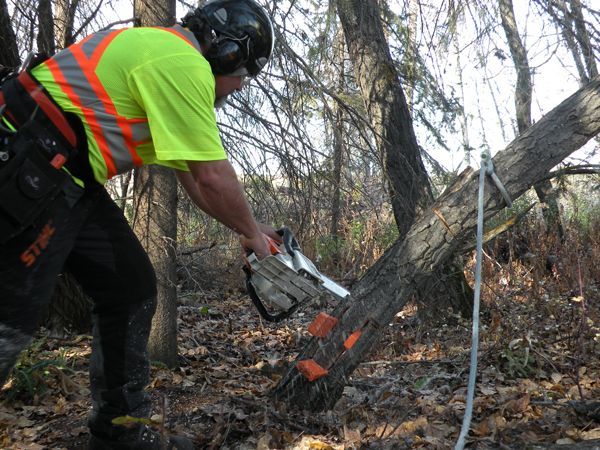
City of Red Deer arborists demonstrate the safe felling of a dead, snagged tree.

November 13th, 2011

Jill demonstrates the safe felling technique of a dead and snagged tree, with the assistance of her co-workers using mechanical advantage and a pulling line.

Shane Blacktop shares a story about safety and taking your time.

November 13th, 2011

An Arboriculture Canada alumni shares a story that illustrates the importance of taking your time and safety.  Thanks for sharing Shane – the more that arborists share their experiences, the more likely it may save someone elses life as well!

The Culture of Arboriculture

October 15th, 2011

Have you been hurt or experienced a near miss because you knowingly took a chance?

Can you think of a time when in an attempt to complete a job before dark or to salvage a bad bid, an accident occurred?

I recently was lucky enough to attend the ISA International conference and tree climbing championships in Australia. I enjoyed my time there very much and due to certain circumstances I was asked to give a presentation for Dr. John Ball as he was unable to attend. Dr.Ball is a professor at South Dakota State University and I have known him personally and professionally for many years. Giving another person’s presentation is a great privilege because you learn so much, and I thank Dr. Ball for considering and trusting me. I was particularly impressed in the way this presentation ended and it is the impetus from which I write this article. In my previous article I said I would be sharing specific methods for identifying tree failure potential and location and I will do that next issue.

The presentation summarized is about the causes of arborist fatalities, fatality statistics, and standards/legislation from a global perspective. It outlined what the fatality averages are in countries around the world and looked at their causes. It also explained what standards or legislation exists in countries around the world.

However, what struck me were the last couple slides where Dr. Ball states that even though training, legislation and standards exist in many countries the accident and fatality rates are still quite high and their causes similar, globally speaking.

This raises a thought provoking question – why?

While accidents and fatalities are lower in countries where mandatory training and credentialing exists and the incidents are lower in these countries than countries that do not have tree work specific legislation or standards, the accident and fatality statistics are still quite high. Globally, commercial arboriculture ranks in the top 5 most dangerous occupations.

In pondering the statistics I believe it has something to do with the culture of arboriculture. Generally speaking, people who enter this field and stick with arboriculture a year or two have some common traits; such as being a hard worker, a risk taker, and a ‘get ‘er done’ done mentality. I believe that this is in part why we have accidents and fatalities. Another significant contributing reason is that arborists deal with many variables and every tree is unique and poses different risks and challenges almost every time, regardless of the work being performed.

There is evidence to suggest that while we understand and evaluate risks and hazards we must do a better job in mitigating and eliminating the risks and identified hazards as part of our regular work practice.

We need to use our intelligence, caution and preventative measures to protect ourselves when doing tree work. It is not enough to have standards, legislation and certifications and to simply evaluate risks and document the assessment procedure. We need to act on the identified risks and diligently address them by putting in place barriers or eliminating the hazards as part of the work plan.  This is important for all aspects of tree work and for the types of equipment that are being used.

Chippers are one of the most dangerous tools we use and yet chipper training or standards that outline safe chipper operation are very limited in most cases.  Another area to give more consideration to is electrical awareness, as electrocution tops the list for fatalities to commercial tree workers according to the sectors of government who investigate fatalities.

As tree workers it is incumbent on us all to change the hard and fast production mentality and actively practice safe work practices that include not only risk assessment but management as well. We need to prioritize and focus on the equipment and activities that are statistically the most dangerous, such as limits of approach, electrical awareness, chipper and chainsaw operation.

Many of us were trained to work hard and do almost whatever it takes to complete jobs in a profitable manner and in certain situations take changes that shouldn’t be risked.  I know I saw this happen as a ground worker and carried forward this thinking when I began to lead crews. Thinking back to my days in the production field I can remember when we hustled to finish a job before dark to avoid the time and costs of returning the next day. I also can recall accidents and near misses that at their root were caused by this thinking.  This mentality can develop a culture that leads to problems. Legislation, training, licensing and certification is not enough; we need to more diligently apply risk reduction strategies, work in ways that reduce or eliminate identified risks and through communication and work strategies demonstrate to all that this is important.

Everyone one of us who works with others on a crew or in a lead role is a trainer and we need to think about what message we are sending to the next generation of tree workers – what  are we teaching them?  

An important message should be that safety is paramount and that when it comes to safety we do not let other factors push us to take the chances that make arboriculture one the most dangerous occupations.

Until we see a measurable reduction in the statistics we have justification to improve. When the statistics show a reduction then we may have been successful in changing the culture of arboriculture.

The presentation ended with a photograph of a placard on a large piece of industrial equipment and it said; ‘This machine does not have a brain, use yours.’ Shields, guards, emergency stops, brakes and PPE are not enough – we also need to change our thinking and habits.

Experience, thought, planning and actions that reduce and eliminate risks is the most important piece of safety equipment we have. It is in our heads.


Key Notch – Technique for releasing uprooted trees that are hung or snagged.

May 8th, 2011
 

In some cases trees are hung or snagged because they have been uprooted.  In these situations determining where the loads are concentrated can be difficult, and often the root plate is a stronger force to be considered than the hung tree itself. Gravity is always acting on mass and never takes a day off.

This uncertain circumstance presents challenges that must be considered when attempting to cut the tree free from obstacles. The main focus of the cuts I have described in my past two articles (mis-match cut and controlled hinge release) has been to allow the cutter to be at a safe distance when the final cut is released and the tree falls and is cleared from its snagged position. The use of a rope and mechanical advantage allows cuts to be released in a controlled manner and the tree to be pulled from a safe working distance while trying to free it. For safety’s sake always plan, prepare and use an escape route.  Avoid cutting and releasing a snagged tree while standing next to it by creating a barrier using distance and rope. The further away you are from the snagged tree – the better (within reason), but a good rule of thumb is to be a distance away that is equal to the height of the snagged tree.

The key notch is a technique for freeing a hung or snagged tree that releases all holding wood while maintaining control until a pull force is applied. It takes some time to cut and works well on trees that are hung and snagged where the compression and tension forces are very difficult to identify, such as with uprooted trees.

First evaluate and determine the zones most likely under compression and tension. In the case of an uprooted tree, the compression and tension zones can be exactly opposite that of a tree in the same hung or snagged position that is not uprooted. The techniques of the key notch will work the same for either situation. This is why it works well for trees where it is difficult to determine how much force the root plate is applying.

The key notch is made with five cuts.

 The key notch is made by making five cuts into the trunk; the first three cuts utilize the bore cut technique, cutting through the trunk and forming a tongue and groove – or ‘key’. The tongue and side of the groove should be of equal size or thickness. This is determined by dividing the trunk diameter into three equal parts. In order to properly form the key notch, it is necessary that the trunk be at least three times the diameter of your chainsaw bar width.

Use of wedges with the key notch.

 Before making the final two cuts wedges are installed to prevent saw bind and pinch. The wedges are placed under the tongue on both sides of the trunk and wedges can also be inserted into the sides of the key as well. This requires several wedges, but a minimum of two will often work. The fourth cut is made in the compression zone and the final cut should be placed in the area of the trunk that is determined to be under tension.  By releasing a load in tension the kerf should open and allow the key notch to be completed without any bar pinching. 

Using wedges with the key notch

Once the cuts are completed the worker should retreat to a safe working distance and pull the snagged tree out of the key, using a pre-installed pull line. Pulling the tree out of the key may require more force than one person can apply and that is where mechanical advantage is incorporated into the pull.

Using mechanical advantage for releasing the key notch ensures that workers are at a safe distance.

It is my intention in writing these articles and sharing techniques, to add tools and techniques to the mental toolboxes of workers who use chainsaws to cut trees that are hung and snagged during or after storm events. I realize that there are many different tools and techniques and I always encourage workers to stick with ones that have worked well for you.  I also equally encourage everyone to always keep an open mind and give new techniques a chance and a try.  See if they work for you, and when they do you have another tool for the toolbox!


Controlled Hinge Release – releasing lodged or hung up trees.

May 8th, 2011

In my last article I shared a technique for safely releasing lodged or hung up trees.  I am going to expand on this concept in this article.

One disadvantage of the mis-match cut is that in some cases, the vertical wood fibre lamination may release before the saw operator is at a safe distance away.  It is a rare occurrence, but it can happen and is an example of why alternative techniques are always good to have in the mental toolbox.

The controlled hinge release is another technique for releasing hung or snagged trees that can offer some additional control when cutting these types of trees.

Controlled hinge release techniques at work.

The controlled release hinge technique is employs the use of a notch and also requires the hinge to be established using a bore cut.  The notch and hinge are set before the final back cut is made and optimizes safety by using a mis-matched back cut and a pull line to release the tree when the operator is ready and clear of the danger zone.

An open face notch is cut in the opposite side of where the pull line is installed. This way when the tree is pulled, the notch closes and the tree hinges towards the pull line. The placement of the notch should not only consider the pull line direction but also the side that best facilitates the dislodging of the snag or hung tree.

Preparing to by-pass the strap.

The bore cut establishes the hinge which should be made thinner than normal when dealing with a standing tree.  Instead of the standard 10% to 7% of diameter, a maximum of 5% to 3% should be used. This is due to the lack of bending moment that exists in hung or snagged tree scenarios.  A limitation of this method is that it is best suited for large enough diameter tree where there is enough wood behind the hinge to allow for the bore cut to be made and in situations where the butt of the tree is not attached to the roots or dug into the ground.

First attach a pull line to the tree and install any mechanical advantage needed to pull the tree. Once the notch and hinge are cut, you will have the small portion of wood left uncut at the back of the tree – commonly called the ‘strap’.  The final step is to place a by-pass or mis-match cut just below the bore cut and cut far enough so that this kerf passes the kerf above, creating a mis-matched strap. This will hold or control the release of the tree until a load is applied to the pull line.

The strap releases and the tree will fold or ’walk’ in the direction of the pull line when the tree is pulled.  Often this action is enough to dislodge the hung tree or snag.  If it does not, the line is moved up and the technique is repeated. The repeated cuts move the snag or hung tree in a lateral direction, encouraging it to dislodge and keeping the snag from becoming more vertical where it is likely to fall unpredictably when it dislodges. The controlled release hinge maximizes cutter control and safety.

Bore cutting the back cut of the controlled hinge release.
Safe working distance.
Using mechanical advantage to dislodge a snag.

An article is no substitute for hands on training and this article is intended to stimulate thought.  I trust my description along with the photo’s can help you to understand this very effective technique for freeing hung or snagged trees.

Too often a variation of this technique is used with a conventional back-cut, where the notch is cut in the upper side of the snag and the hinge is formed with the cutter standing right beside the tree and a very quick and abrupt jump is made in an attempt to escape as the tree releases and hinges.  Control is not part of this technique and can result in the cutter being struck or pinned by the butt of the tree.  This technique also moves the tree closer to the snagged or hung obstacle, causing the tree after frequent attempts to become more and more vertical resulting in a very large and dangerous drop zone.

It is a known fact that 90% of all tree cutting accidents occur within 5 feet of where the final cut is made, within 15 seconds of the tree beginning to fall or hinge. This is called the 5-15-90 rule. It stands to reason that if the tree can be released at a distance greater than five feet and before falling or hinging action begins that the likelihood of being injured is reduced by 90%. It is with this thought in mind that the controlled release hinge is utilized.

In my next article I plan to share another technique which is well suited for scenarios where an uprooted tree is hung or snagged, or where the butt of a snagged or hung tree is dug deep into the ground.

Dwayne Neustaeter

Continental Connection – Issue #10 – Spring 2011

February 20th, 2011

The Spring 2011 Continental Connection is here!  Read about how to understand what types of certificates you need, what regulations to watch for, how ArborCanada keeps chainsaw training up to date and an excellent article from Kevin Smith about Humus and Soil Fertility.  http://www.axmag.com/data/201102/U13949_F21831/index.html 

Chainsaw Intensive Train the Trainer

February 6th, 2011

Chainsaw Intensive Train the Trainer on YouTube

Catch a snapshop of the Chainsaw Intensive Train the Trainer event – Jan. 30  – Feb. 4, 2011!

CUT STRAIGHT!

February 6th, 2011

  Arboriculture Canada chainsaw instructors and associates gathered together for Chainsaw Instructor Intensive Training Camp 2011, in the Peterborough, ON region at Elmhirst’s Resorts from Jan. 30 – Feb. 4th.  The purpose:  to review, develop and collaborate together on improving our teaching techniques and updating our course resources with a specific focus on technical tree falling, hazard & danger tree cutting and advanced chainsaw safety, operations and maintenance.

Nine instructors and industry experts from Canada and the US attended this intensive train the trainer program.  The group included: 

Dwayne Neustaeter – Train the Trainer Instructor

Dave Ward – Arboriculture Canada Instructor

John Ransom – Arboriculture Canada Instructor

Mark Cooke – Arboriculture Canada Instructor

Matt Logan – Arboriculture Canada Instructor

Danny LeBlanc – Arboriculture Canada Instructor

Michael Harrell – North American Training Solutions Instructor

Bob Smith – Humber College Instructor

Andrew Hordyk – Arboriculture Canada Instructor

Instructor Group - Chainsaw Intensive Train the Trainer

The program included an in depth analysis of the competency profiles for each of the chainsaw modules offered by Arboriculture Canada.  Teaching templates, power point materials, course workbooks and exam questions and format for all blocks of instruction in our chainsaw modules were reviewed and discussed.  The purpose of this process is to ensure that skills, techniques and methods are safe and modern and instructional material is consistent across the country in the following modules: 

  • Chainsaw Safety & Cutting Techniques
  • Technical Tree Falling & Cutting
  • Advanced Hazard & Danger Tree Cutting & Falling
  • Hazard & Danger Tree Cutting Techniques for Power Service Restoration

This panel of experts in our industry draws on a combined 150 plus years of experience using chainsaws and working in the urban forest, from owning and operating tree services, working for municipalities and teaching in college environments.  This experience, expertise and shared knowledge serve to strengthen and improve course curriculum and teaching methodologies of our courses.

Attendees delivered a block of instruction in camera and before their colleagues, which was followed by a peer review and feedback session on all aspects of the instruction, including the strengths and weaknesses; from introduction, use of accelerated teaching techniques and suggestions on ways to increase retention and the effectiveness of teaching the content.  A day was spent in the snow at the edge of the lake, studying and practicing advanced tree falling and cutting techniques.  An evening of chainsaw maintenance in the shop, tearing down saws, examining maintenance practices and learning from each other was a techie’s dream.

Our customers will see new course workbooks for all chainsaw training modules in 2011.  A complete rewrite of these modules has recently been completed, with accompanying photo’s, diagrams and illustrations to better supplement the learning during the training programs.  These new workbooks provide additional resource material which will strength the retention of learning and supply a resource that can be used following the course to remind students of the skills that they learned.  In time, this learning resource will be available for sale to arborists and chainsaw professionals outside of our student groups and around the world.

The mantra of the week – ‘Cut Straight’ – reverberated strong and was heartfelt.  Each instructor is passionate about teaching, and is especially passionate about reducing the accidents and fatalities caused by chainsaw accidents, cuts, and ‘struck-by’s when falling and cutting trees.  This week was dedicated to studying the techniques used in chainsaw operations and tree felling, as well as learning and practicing teaching skills that will continue to make the programs delivered by Arboriculture Canada instructors effective and leading edge.

The unique personality, passion, authenticity and power of purpose was evident and strong in this group.  Arboriculture Canada is proud and privileged to be associated with such quality people.  To quote the creativity and quick wit of Bob Smith – all our customers can be assured that our instructors ‘gauge the depth of their cutting edge personalities’! 

Arboriculture Canada offers instructor training privately for small groups of people.  Contact us to learn more about how you can get instructor training that reveals the secrets of how to deliver high energy, memorable and effective presentations using adult learning techniques such as; suggestology, accelerated learning, edutainment and educomedy.

Chainsaw Intensive Train the Trainer – A Glimpse!