


.png)

The Evolution of Climbing Systems - An Arboriculture Perspective
Co-Authored by:
Tony Tresselt, DJ Neustaeter & Dwayne Neustaeter
Tree climbers and arborists have always depended on rope systems for essential tasks like pruning, climbing, and safely removing branches or entire trees. Over the decades, climbing tools have evolved dramatically. Understanding this evolution reveals how innovation improves climbing safety, boosts efficiency, and shapes our approach to tree care.
The Evolution of Tree Climbing Systems
The Early Days of Manila Rope

In the early 1900s, tree climbers primarily used manila three-strand rope. This strong material was favored for its flexibility and ability to handle substantial weights. For example, a standard 1-inch manila rope can support loads of over 3,000 pounds. This made it ideal for pulling heavy branches and ensuring that parts of trees could be lowered safely.
Despite its reliability, manila rope was heavy and cumbersome. Throughout the mid-20th century, few significant changes occurred as climbers remained attached to the conventional methods learned from their predecessors. The industry seemed stagnant, relying on what felt familiar, despite growing safety concerns.

It is interesting to note that the use of rope for climbing and rigging dates back to ancient times. One impressive example of this is the use of rope to move and lift an ancient Egyptian obelisk, which stands today at the center of Saint Peters Square outside The Vatican, Rome, Italy. Dating back over 4000 years, it was transported to Rome from Alexandria by Emperor Caligula in 37 AD.
This ancient Egyptian obelisk, measures 25.5 meters, and including its base, it reaches a height of 41 meters and weighs 331 tons, that is 729,730 lbs.
Under the directive of Pope Sixtus V, it was relocated to the center of the square in 1586. The monumental task of re-erecting the obelisk involved a workforce of approximately 900 men and nearly 100 horses, and you guessed it... allot of rope.

The Advent of Synthetic Fibers

Fast forward a few thousand years and let's go back to tree climbing with rope. The game began to change with the introduction of synthetic fiber ropes in the late 20th century. These modern materials, such as nylon and polyester, offered advantages over manila ropes. They were lighter, with some synthetic ropes weighing up to 50% less than their manila counterparts but also provided greater strength. For instance, a synthetic rope with a diameter of just 7/16 inch can support loads comparable to a 1-inch manila rope.
Synthetic ropes like ArborPlex emerged, designed to enhance the climbing experience. However, the shift to synthetic fibers came with challenges. Climbers had to learn how to manage the new material's unique characteristics while still ensuring their safety and effectiveness.
Adapting Techniques: From Taunt Line to Blake's Hitch

Many climbers initially resisted using synthetic ropes, sticking with traditional techniques. However, as synthetic materials became the norm, techniques like the taunt line hitch began to evolve. Climbers slowly adapted these established methods, hoping to make them compatible with their new ropes.

Eventually, climbers recognized the limitations of the taunt line hitch. The Blake's hitch emerged as a preferred option, as it provided a more reliable grip, reducing the chances of slipping. This transition represented a significant shift in the climbing community. It marked a period where traditional practices were questioned and improved to elevate safety and efficiency.

Innovations in Climbing Systems
As the Blake's hitch gained acceptance, climbing practices rapidly evolved. Innovations in gear, such as vibrant colored ropes and custom designs, began catering to different climbing styles. For instance, tree climbers could choose bright ropes for increased visibility. Furthermore, the introduction of micro pulleys and carabiners allowed for efficient slack tending. These small but crucial innovations helped climbers position themselves more effectively and improved overall safety. As climbers embraced new tools, the potential for developing stronger and safer systems expanded significantly.
The Role of Competitions in Advancing Techniques
Competitions, such as the International Tree Climbing Competition, play a significant role in pushing the envelope for climbing systems. These events not only showcase cutting-edge techniques but also encourage climbers to experiment in a competitive environment. Local chapter competitions serve as platforms where climbers can share knowledge and skills, fostering rapid development within the community.
As competitors demonstrate refined techniques and top-quality equipment, the climbing community eagerly absorbed these lessons. Innovations from these events quickly spread, transforming standard practices and enhancing safety measures across the board.
Emerging Techniques & Innovation
The first official "ISA Jamboree" was held in 1976 in St. Louis, MO. Over the years, new events and techniques were introduced and a formal set of rules was developed. With the rise of new ideas, several techniques gained prominence. The split-tail system, for example, allowed climbers to manage their lines better, creating more efficient methods for ascending and descending trees.

Each new tool, technique, or innovation solved an issue or limitation of the older systems. Climbing systems became more complex, more specialized, but also more efficient and much safer.
As the tree climbing industry headed to more and more specialization, more hardware and software tools specifically for climbers came into vogue. As a consequence of this growth, the terminology and understanding of these new tools and techniques needed to change.
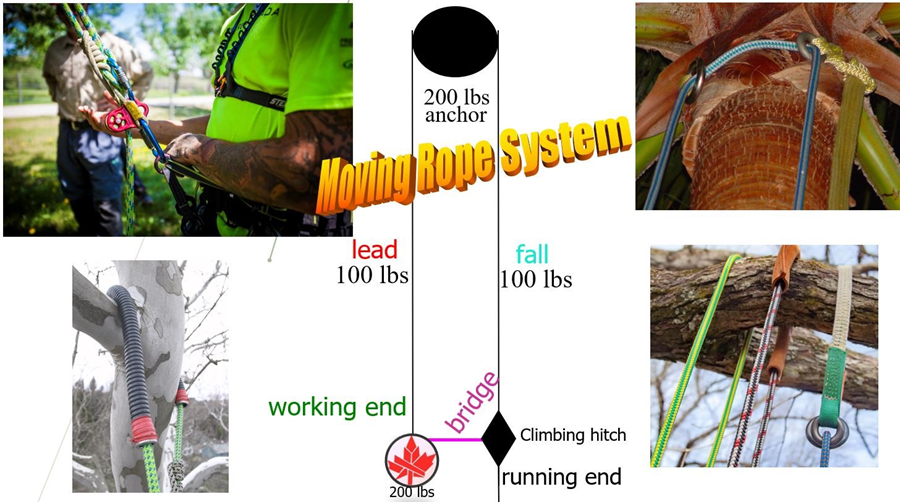
Today, we have MRS, or moving rope systems. Modeled off more traditional tree climbing systems, they still offer many advantages in ergonomics, efficiency, and safety.
We also have SRS, or stationary rope systems. Modeled off other work at height industries and recreational climbing pursuits, they too offer much in the way of ergonomics, efficiency, and safety.
It is important to note that stationary rope systems (SRS) can come in the form of a base anchor or canopy choke anchor configuration. The notable difference between the base anchor and canopy choke is the load experienced at the canopy branch attachment anchor point. When base anchored, this load can come close to almost double the weight held on one standing leg of line in the system. As a general rule this is referred to as a 2:1 load ratio when base anchored as depicted in the diagram bellow.

When choked the load at the canopy anchor is 1:1. Both types of systems MRS and SRS use the advantage of throw lines to set high tie-in points and or multi-part anchoring systems as needed.


As the techniques became more refined, hardware and software specifically for tree climbing began to be produced and sold. Both moving rope systems (MRS) and stationary rope systems (SRS) brought innovation and advancement to the Arboriculture industry.
An example of this is the Rope Wrench, a friction management device designed by Kevin Bingham. A link to one of the early designs by made by Kevin is linked bellow:
In the history of stationary line use (SRS) in North America, arborists are the last high angle discipline to adopt this system. Through the 60’s and 70’s spelunkers and mountaineers forged ahead with single line ascent and descent systems. In SRS systems, friction management is key to a smooth and safe descent. One of the earliest direct ways to manage friction is the use of the Munter's Hitch. This hitch was popularized through the 1950's - 1970's, with roots in caving and mountaineering.

Techniques and innovation in stationary rope entered the scene from Europe and the rock, ice and cave recreational climbing communities. One notable example of this in the United States is Bill Cuddington, widely acknowledged as the father of vertical caving. Bill Cuddington pioneered stationary rope techniques for more than half a century. His story is told in, Vertical Bill: The Story of Bill Cuddington and the Development of Vertical Caving in America by David W. Hughes, is a classic and bears a read through for any serious student of the rope.

Other notable contributors to early rope techniques are Bruce Smith and Alan Padget, the authors of On Rope, a book often considered the encyclopedia of stationary rope information. Stationary line use in arboriculture is not new. As early as the late 1980’s tree climbers started to dabble in systems where the rope stayed still as the climber moved over it. In its earliest stages 1:1 rope systems in arboriculture were typically ascent methods. Unlike spelunkers, tree workers developed stationary rope systems for tree care with a twist. Traditional tree climbing systems involve a single rope or line moving over an anchor point. This creates a 2:1 mechanical advantage, but doubles the amount of rope that must go through a system as opposed to the vertical gain. In a 2:1 system a climber must move two feet of rope to gain one foot in elevation.
Looking Ahead: The Future of Climbing Systems
The future of climbing systems for arborists holds exciting possibilities as technology continues to advance. Developers are exploring materials that prioritize safety, durability, and performance. Mechanical devices which are midline attachable and have adjustable friction management are emerging. Even battery powered ascent devices used to effortlessly winch our way to height have made it to the modern market.

For 50 years and counting Petzl has being supporting and innovating technology in the vertical world for people who hang from rope. It does not matter if it's for work, play or both, Petzl has been committed to keeping you safe and efficient since the early days. If you're looking for quality products that are safe, intuitive and efficient, look no further than Petzl.
As innovation in rope access grows, so does the network of professionals who work at height. Rope access skills span across various professions including rescue, recreation and industry. It is important to learn from each other and stay connected. The more we share the more we can improve efficiency and safety in our operations. Community platforms and online resources are making it easier to share information and stay connected in a vertical world. This can also help to flatten the steep learning curve for new climbers.
Final Thoughts
The evolution of climbing systems showcases the adaptability of tree climbers and arborists. From early manila ropes to modern synthetic fibers and innovative techniques, each change has aimed to enhance safety and efficiency. The ongoing technology advancements promise to bring new materials and systems to the forefront, further refining tree care practices.
We have come a long way from the days of manila 3-strand, and we have a long way to go to reduce hazards and incidents in the tree care industry. But creative arborists with a drive for innovation build on the tools and techniques of the past to forge new and better ways to help climbers ascend canopies and care for trees.
By embracing these changes, the climbing community can continue to evolve and excel in their craft, ensuring that they remain leaders in the field of tree care and conservation for years to come.
Contributions and References:
International Society of Arboriculture (ISA) - ITCC 2022 Video
Petzl Professional - Access the Inaccessible
Sterling Rope Add
Skylotec ACTSAFE
Vatican.com (History of the Egyptian obelisk)
Kevin Bingham - ISC Rope Wrench
Arboriculture Canada Training & Education ltd
On Rope - Bruce Smith & Allen Pagett
Vertical Bill: The Story of Bill Cuddington and the Development of Vertical Caving in America by David W. Hughes
James Luce - Photo with early rope wrench design
To all arborists and supporters of the tree industry past, present and future. Thank you for mutual reciprocity, keeping each other safe and growing our industry together. See you in the trees.


Comments